
Who Is Jean Phil? How to Make Jean Phil-Style AI Videos
A burly Frenchman in a brown houndstooth suit stands in the middle of a Paris street. He looks at the camera with a completely straight face. Then, without warning, he starts shadowboxing.
That's it. That's the video.
In less than three weeks, that formula turned a brand-new account called @jean_philanthrope into one of the biggest internet stories of the season: 200K+ followers on TikTok, 235K on Instagram, 33 million+ views — all from just eight posts.
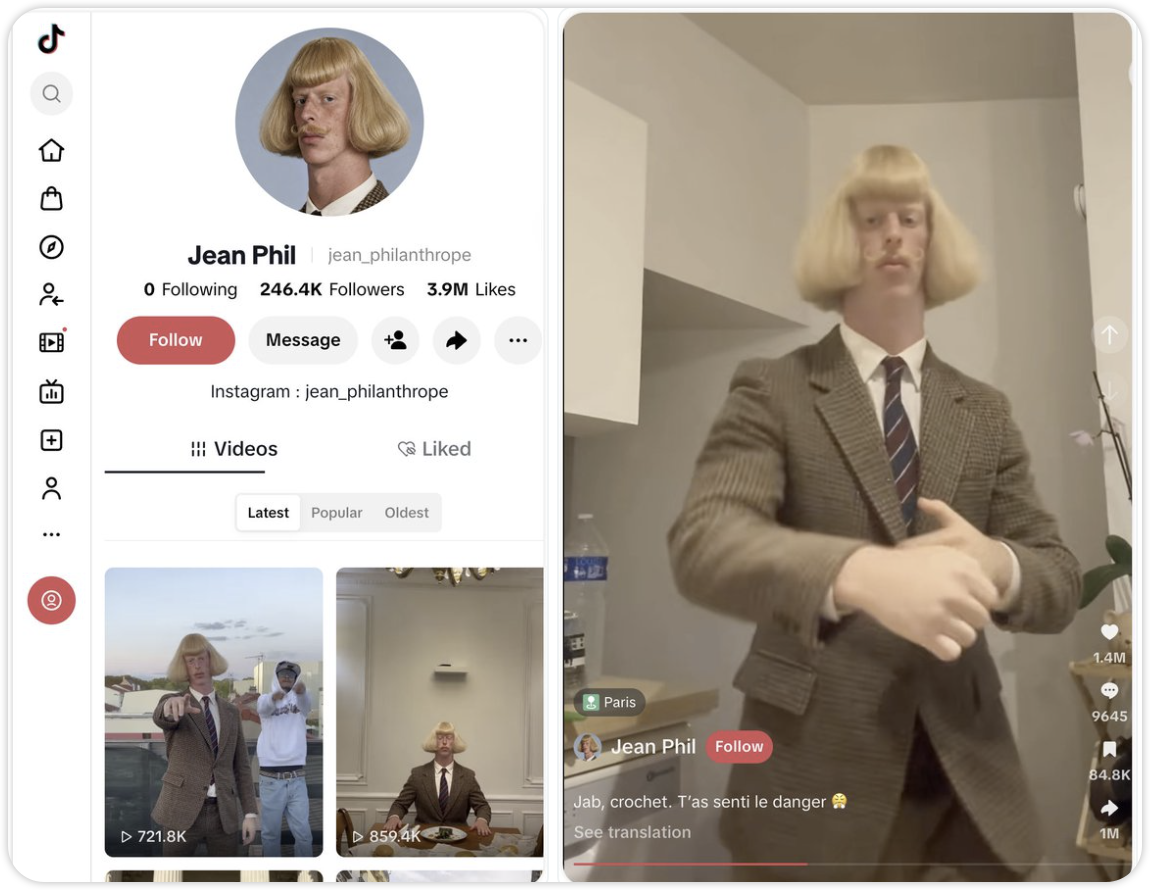
There's just one catch. Jean Phil is not a real person. He's an AI-generated character, and once viewers figured that out, the reaction was unlike anything the AI influencer space has seen before.
In this guide, we'll cover who Jean Phil is, why he went viral, the controversy behind him, and — most importantly — how to create Jean Phil-style AI influencer videos with your own original character (without the scam part).
Who is Jean Phil?
Jean Philanthrope — "Jean Phil" for short — is an AI-generated internet persona that appeared in mid-September 2026. The character is instantly recognizable:
- A bleach-blonde bob cut that viewers have compared to Lord Farquaad from Shrek, a poodle, and an Elizabethan king
- A curled handlebar mustache
- A brown houndstooth suit and tie, worn in every single video
- A stoic, unbothered expression — he never smiles, no matter what he's doing
The premise of every video is identical: Jean Phil goes somewhere ordinary — a boulevard, a park, a café, an art gallery — and suddenly starts shadowboxing at the air, deadpan, while French rap plays in the background.
His first post appeared on Instagram on September 17, 2026: Jean Phil shadowboxing in an apartment. Three days later, his first TikTok — shadowboxing on a street — had 1.5 million views. A follow-up of him boxing under a tree in a park (set to Nelly's "Dilemma") passed 5.6 million views on TikTok and a quarter-million likes on Instagram within the same window.
By early October, his eight videos had generated 33+ million views and 3.6 million likes on TikTok alone, with individual posts ranging from 1.7M to 9.8M views. Commenters crowned him "the next internet star." Someone admitted: "This guy could beat me up and I'll thank him." Another simply said: "Bro looks like he invented history."
Is Jean Phil real?
No — and this is where the story turns.
Jean Phil is 100% AI-generated. Creators quickly confirmed that his likeness circulates as an "AI overlay," and the character almost certainly came out of the new wave of AI influencer generators that let you build a consistent photorealistic persona and animate it with motion transfer.
But the bigger reveal was why he exists.
Around September 20, an X (Twitter) account using Jean Phil's name and likeness began promoting a Solana memecoin called $JEANPHIL. His Instagram bio linked to the same token via Pump.fun. In other words, Jean Phil wasn't built to entertain — he was built as a marketing funnel for a crypto pump-and-dump.
The numbers tell the story: the $JEANPHIL token spiked on September 20, hit a high of $0.02845 on September 21, then lost more than 99% of its value before the end of the day. AI literacy educator Jeremy Carrasco pointed out that the account behind the character had changed its username six times in fifteen months — a telltale sign of a serial pump-and-dump operation hiding behind a fresh face.
He's not alone, either. A British counterpart named Archibald Brown — another AI character with his own memecoin, $ARCHIBOLD — was introduced as Jean Phil's "boxing rival," staging challenge videos to farm attention for the same play.
Followers felt betrayed. "I was so disappointed to find out this was AI. I never get tricked by AI. I was tricked by AI," one wrote. Another: "Him being AI is like finding out Santa isn't real." Research from YPulse shows 70% of European 13–24-year-olds say they wouldn't want to follow a computer-generated account — the gag being that, as Jean Phil proved, most of them genuinely can't tell anymore.
The takeaway isn't "AI influencers are scams." It's that the character worked — the look, the formula, the deadpan energy. What was toxic was the memecoin bolted onto it. Which raises the question people are actually asking Google:
What tool was used to make Jean Phil?
Search interest in "how was Jean Phil made" spiked right alongside his follower count — and notably, searches for AI influencer generators (including Higgsfield's AI Influencer Studio, which launched in January 2026) surged in the same window.
While nobody has confirmed exactly which tool produced Jean Phil, the workflow behind him is no secret, because it's the same workflow every viral AI influencer of this generation uses:
- Build a consistent AI character. Instead of writing long prompts and hoping the face stays the same across renders, you design a character once — face, hair, build, outfit — and lock that identity.
- Generate a master image. One clean, high-quality reference portrait becomes the anchor for every scene that follows.
- Apply motion transfer. Take a real video of a human moving (in Jean Phil's case: the shadowboxing) and transfer that exact motion onto your AI character.
- Keep the formula, change the scene. Same suit, same face, same camera angle — new location each time. The repetition is the brand.
That last point is why the trend is so easy to replicate responsibly: the viral ingredient is the motion and the deadpan formula, not the specific face. You can build your own original character — your own haircut, your own outfit, your own running gag — and ride the exact same wave without copying anyone's likeness or laundering a memecoin.
How to make a Jean Phil-style AI video (step by step)
This is where it gets practical. The workflow below uses AI motion transfer: you take a viral-style reference video and a character image of your own, and let the model combine them.
You can run the whole thing in the Jean Phil Style AI Influencer Generator template on Oimi — here's the full workflow:
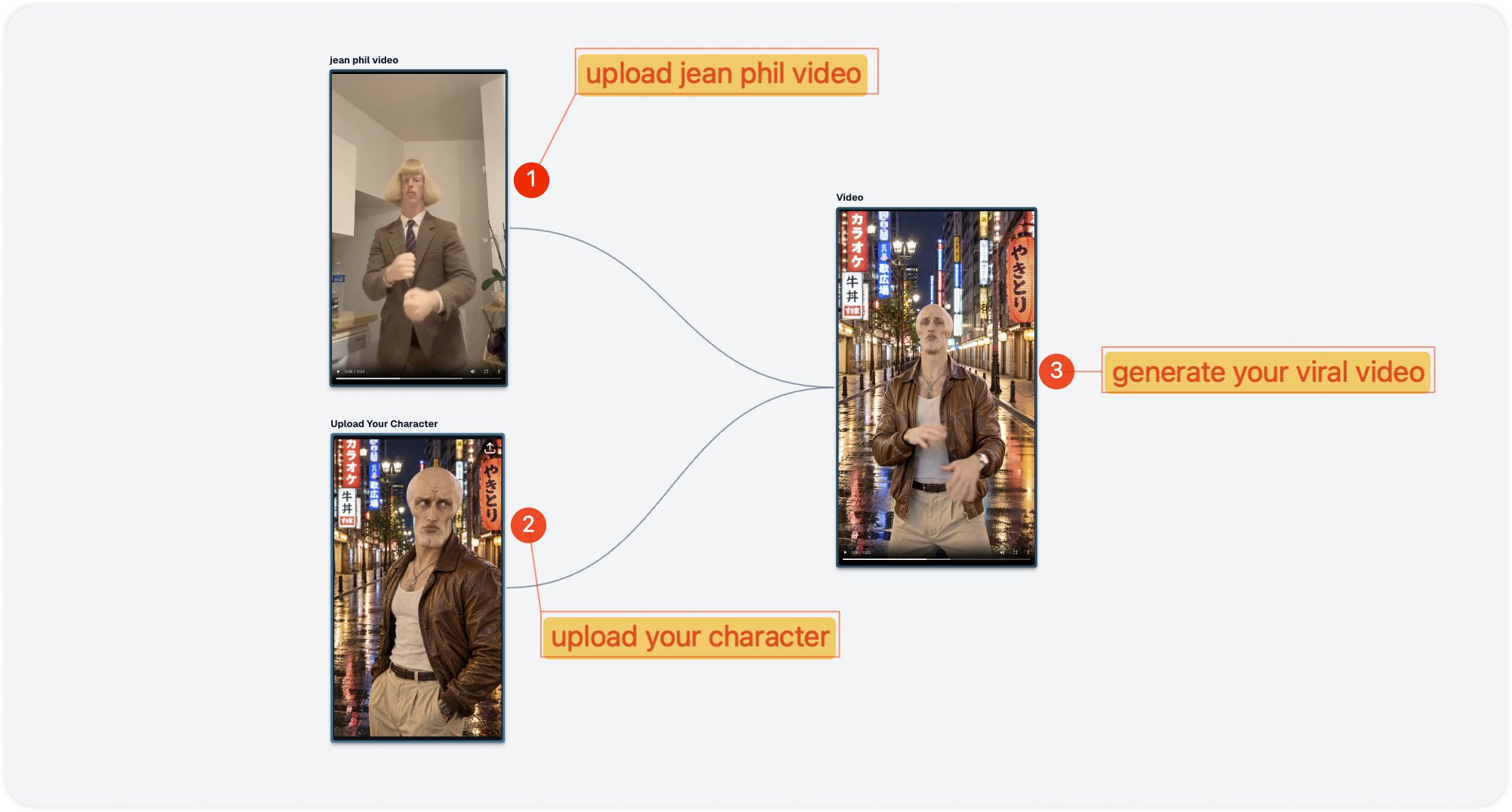
Step 1 — Pick or upload a reference video.
Use a viral social video with a static background (background stays fixed, only the subject moves — like Jean Phil's streetboxing clips). Tip: you can trim any longer clip down to 25 seconds.
Step 2 — Prepare your own AI character image.
Generate your character with AI (not a real person's photo — especially not celebrities or children). Two routes:
- Generate a fresh original character image and upload it, or
- Grab a single frame from the reference video with the background intact, then swap the face, hairstyle, or outfit to create your own twist on the trend.
Step 3 — Connect them with a video node.
Create a new video node, wire the reference video and your character image into it, switch to the AI motion transfer model, and hit Generate.
Step 4 — Wait, review, iterate.
The model transfers the motion — punches, head turns, the whole performance — onto your character while keeping your character's identity consistent. Don't like the result? Adjust the image and re-run.
Step 5 — Repeat the formula.
One video makes a post. A formula makes an influencer. Keep the character, the outfit, and the gag identical; change only the scene. That's exactly how Jean Phil (and every viral AI persona before him) compound attention post after post.
Good to know:
- ✅ Commercial use is permitted for videos you generate this way
- ⏱️ Maximum video duration is 25 seconds (matching the reference clip — trim longer ones first)
- 🎨 Works best on static-background videos where only the subject moves
- 🧑🎨 Use AI-generated characters, not real people's likenesses
Why this trend matters (beyond the meme)
Jean Phil is the first AI influencer where the audience cared that he was fake — which paradoxically proves the format has arrived. Three things worth understanding if you're building in this space:
The formula beats the face. Jean Phil's eight videos are structurally identical. What went viral wasn't a person; it was a repeatable template — look + motion + deadpan + sound. Templates are exactly what AI video tools are good at.
Character consistency is the moat. None of this works if the face changes between posts. Identity-locking (one master image driving every generation) is the single most important technical requirement for any AI influencer.
Trust is the differentiator now. The memecoin crowd burned the audience's goodwill for a quick pump. That leaves a wide-open lane for creators who build AI characters that are actually entertaining — and honest about being AI. Disclosure isn't just legally safer; after Jean Phil, it's a positioning advantage.
FAQ
Is Jean Phil a real person?
No. Jean Phil (Jean Philanthrope) is an AI-generated character. His videos are produced with AI character generation and motion transfer, and the account is widely linked to a $JEANPHIL memecoin promotion.
Where can I find Jean Phil?
His accounts are @jean_philanthrope on TikTok, Instagram, and X. (Whether he's still posting after the crypto reveal is another question.)
Who made Jean Phil?
No creator has been publicly confirmed. The character follows the standard AI influencer workflow — generated persona plus motion transfer — that tools like Oimi and Higgsfield's AI Influencer Studio make accessible to anyone.
Can I make my own Jean Phil-style video?
Yes. You need a reference video with a static background, an AI-generated character image of your own, and a motion transfer model. The Jean Phil Style AI Influencer Generator template on Oimi runs the whole workflow in one canvas.
Is it legal to make AI influencer videos?
Generating and publishing original AI characters is generally fine, and Oimi permits commercial use of your outputs. Don't use real people's likenesses (especially celebrities or minors) without rights, and disclose that your character is AI — platform rules increasingly require it.
What's the deal with the Jean Phil crypto token?
$JEANPHIL is a Solana memecoin promoted through the character's accounts. It crashed more than 99% within a day of peaking — a textbook pump-and-dump. It's a cautionary tale, not a business model.
Keep exploring
- 🥊 Jean Phil Style AI Influencer Generator — run the exact motion transfer workflow from this post
- 🧑🎤 Browse more AI influencer templates
- 📸 See also: What Is Prompt Seen?
Sources: The Tab, YPulse, Know Your Meme, Yahoo Lifestyle, Bored Panda, Dexerto (September–October 2026 coverage).